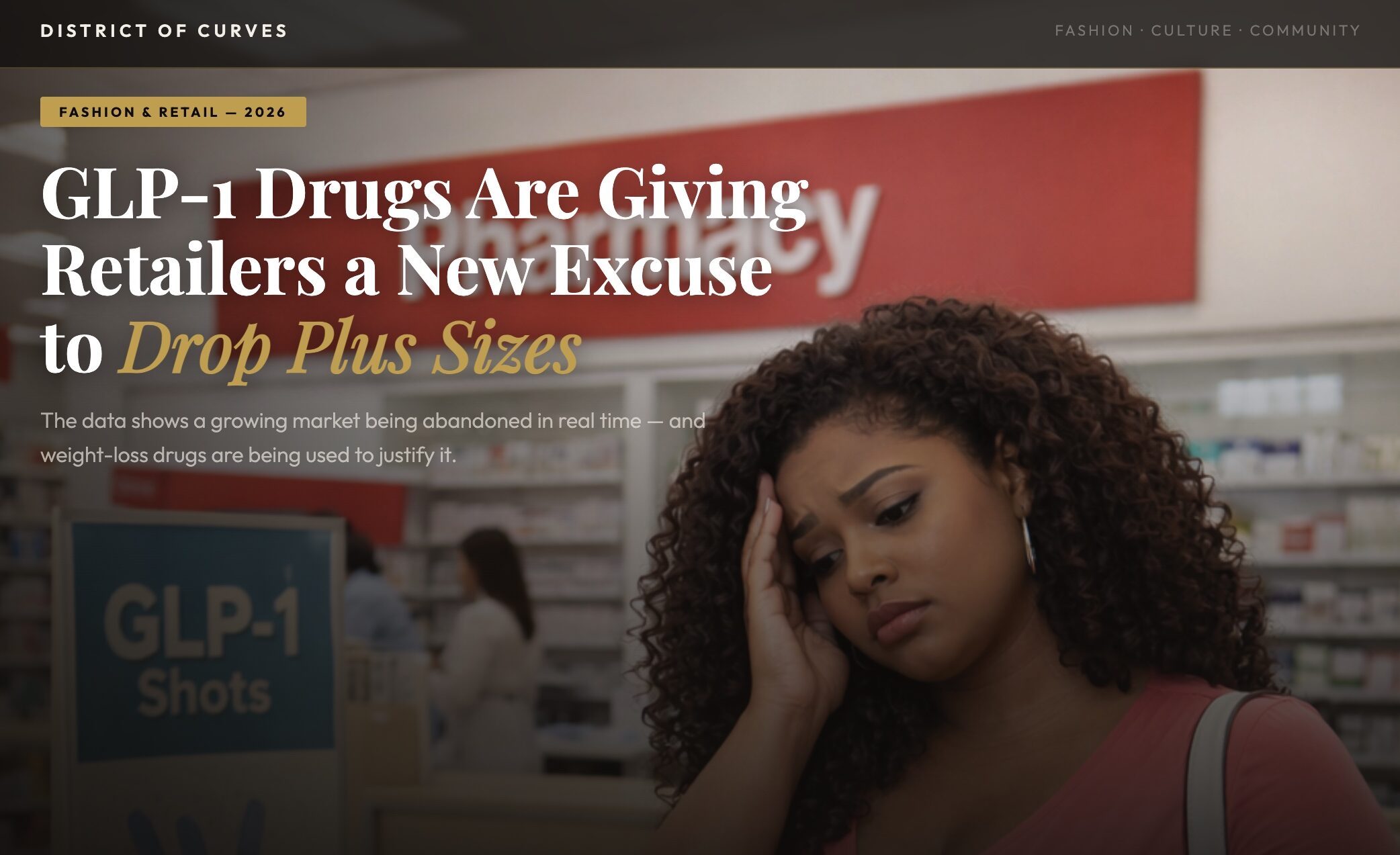
Let’s be honest. Retailers have been quietly walking back their commitments to plus-size shoppers for years. The campaigns were loud, the promises were big, and then — one by one — the racks got smaller, the options moved to the back, and the extended size sections vanished. Now, there’s a new name being attached to the rollback: The GLP-1. And the plus-size community has seen this playbook before.
The rise of weight-loss drugs like Ozempic, Wegovy, and Zepbound has given fashion retail a culturally convenient cover story. As these medications reshape conversations around body size, retailers appear to be recalibrating — or in some cases, retreating — from the plus-size customer entirely. What we’re watching unfold right now isn’t just a business pivot. It’s a pattern, and it’s personal.
The Numbers Don’t Lie — And Neither Do We
According to CNN Business, extended sizes for women’s apparel on Target’s website fell 37% between March 2025 and March 2026, with a 30% drop in the last six months alone. Old Navy — the same brand that plastered “size YES!” across a splashy 2018 campaign — saw plus-size options decline by 12% compared to the same period last year, according to retail intelligence firm EDITED.
These aren’t subtle shifts. This is significant rollback, happening fast, in the middle of a conversation about GLP-1s that the fashion industry is clearly watching closely.
Ann Lindsay, a 41-year-old plus-size shopper in Chicago, told CNN that her local Target had removed plus sizes from the floor entirely. “I see the direction of skinny culture,” she said. “Brands are just falling right in line with what they think people want.”
And here’s what makes this moment particularly sharp: the average American woman wears around a size 16. The CDC reports that the average waist size for women in the U.S. is 38.5 inches — roughly a size 16. Over 68% of American women wear a size 14 or larger, according to research cited by LIVD Apparel. These are not fringe consumers. This is the majority of the market.
GLP-1s Didn’t Start This Fire — But Retailers Are Using Them as Fuel
Here’s what needs to be said clearly: this wasn’t Ozempic’s fault. The exodus from inclusive sizing has been underway for years. Retail analyst Neil Saunders told CNN that the decline is rooted in a familiar vicious cycle — plus sizes don’t sell well in stores, so retailers stock fewer, which attracts fewer customers, which means sales stay low, which gives retailers yet another reason to cut back. A self-fulfilling prophecy, as Mallorie Dunn, a visiting assistant professor at Pratt Institute’s fashion design department, described it to CNN.
Dunn surveyed 300 people with waistlines of 34 inches and up, and found that Old Navy and Target were among the most popular stores for that group. The customers were there. The demand was real. The execution failed them.
Loft pulled its plus sizes from stores in 2021. Old Navy backtracked on its in-store Plus collection commitment in 2022, citing lackluster demand — after years of placing those options in the back of the store, using straight-size models to display them, and dedicating minimal floor space to them. As Kimmy Garris, a plus-size fashion influencer based in Nashville, put it to CNN: “GLP-1s are just an excuse for retailers to continue to push fat people out of the space and just restrict options and continue to mass produce certain sizes of clothing.”
That’s not hyperbole. That’s a read.
The GLP-1 conversation has handed retailers a culturally plausible narrative — one that says the market is shifting, so the sizing is shifting, so pulling back now is simply good business sense. But Saunders himself acknowledged that the pullback predates the Ozempic era. It’s a slow bleed dressed up in a new headline.
What the Market Is Actually Telling Retailers
Here’s the part that stings: the plus-size clothing market isn’t shrinking — it’s growing. According to market analysis from Mordor Intelligence, the global plus-size clothing market is projected to expand from over $315 billion in 2025 to more than $417 billion by 2031. That’s a compound annual growth rate of nearly 5.7%. The customers aren’t going anywhere.
And yet physical retail is behaving as though they are. Torrid, which has been a cornerstone of plus-size retail for years, announced plans to close up to 180 stores by the end of 2025, citing declining in-store sales. The Street reported that Torrid posted a 14.3% year-over-year sales decline in Q4 of fiscal 2025. But analysts at William Blair noted the closures reflect a broader shift toward e-commerce, where the majority of plus-size shopping is now happening — not an abandonment of the customer.
Meanwhile, the runway picture has gotten bleaker. According to Vogue Business’ Autumn/Winter 2025 Size Inclusivity Report, models size 14 or larger made up just 0.3% of looks shown at major fashion weeks — down from an already dismal 0.8% the season before. U.S. sizes 0 to 4 accounted for nearly 98% of catwalk looks. If the runway signals what retail will stock, the community has reason to be concerned.
What GLP-1s have introduced, according to CNN’s reporting, is a “wait and see” mentality among some shoppers who are in the middle of their weight-loss journeys and holding off on buying new clothes until they reach their goal size. DXL, a men’s big and tall apparel brand, estimated that up to 25% of its customers are currently on weight-loss medication. JP Morgan estimated that around 10 million Americans were on GLP-1 treatments in 2025. But DXL’s own CEO Harvey Kanter admitted they can’t clearly isolate what’s driving consumer behavior changes — economic pressure, GLP-1 effects, or general retail hesitancy are all in the mix.
Shannon Clemens, who co-opened The Plus Closet, a Nashville thrift store specializing in larger sizes, offered perhaps the most grounded perspective in all of this: “There’s always going to be people gaining and losing weight, because that is just how bodies work.”
The Community Isn’t Waiting for Permission to Shop
What’s most frustrating isn’t just the empty racks or the shrinking dropdown menus — it’s the signal being sent. As Colleen Marie, a 26-year-old New Yorker who has tried GLP-1 medications herself, told CNN: “Retailers are essentially saying that they’d rather wait for us to get smaller than serve us now.”
That’s a message the plus-size community has been receiving in different forms for decades. It arrived with the “we don’t carry your size” apology. It showed up in the back-of-store section. It came in the form of campaigns that promised everything and delivered almost nothing. GLP-1s are simply the newest chapter in a very old story.
The brands that actually show up — the ones that expand their offerings, build their fits with care, and treat plus-size shoppers like the core customers they are — will be the ones still relevant when this moment passes. The plus-size market is not a trend to ride. It’s a community to serve.
And as eMarketer has noted, reducing plus-size visibility risks alienating a key consumer base at exactly the moment retailers can least afford to lose loyal customers. With the global plus-size market expected to reach nearly $445 billion by 2032, according to Polaris Market Research data cited by eMarketer, walking away from that shopper isn’t just culturally tone-deaf. It’s bad business.
The culture is paying attention. We’re documenting. And we are definitely still shopping — whether the racks want to hold our sizes or not.
Sources: CNN Business (Ramishah Maruf, April 5, 2026); LIVD Apparel; Mordor Intelligence Plus-Size Clothing Market Report; eMarketer; The Street; Vogue Business Autumn/Winter 2025 Size Inclusivity Report.