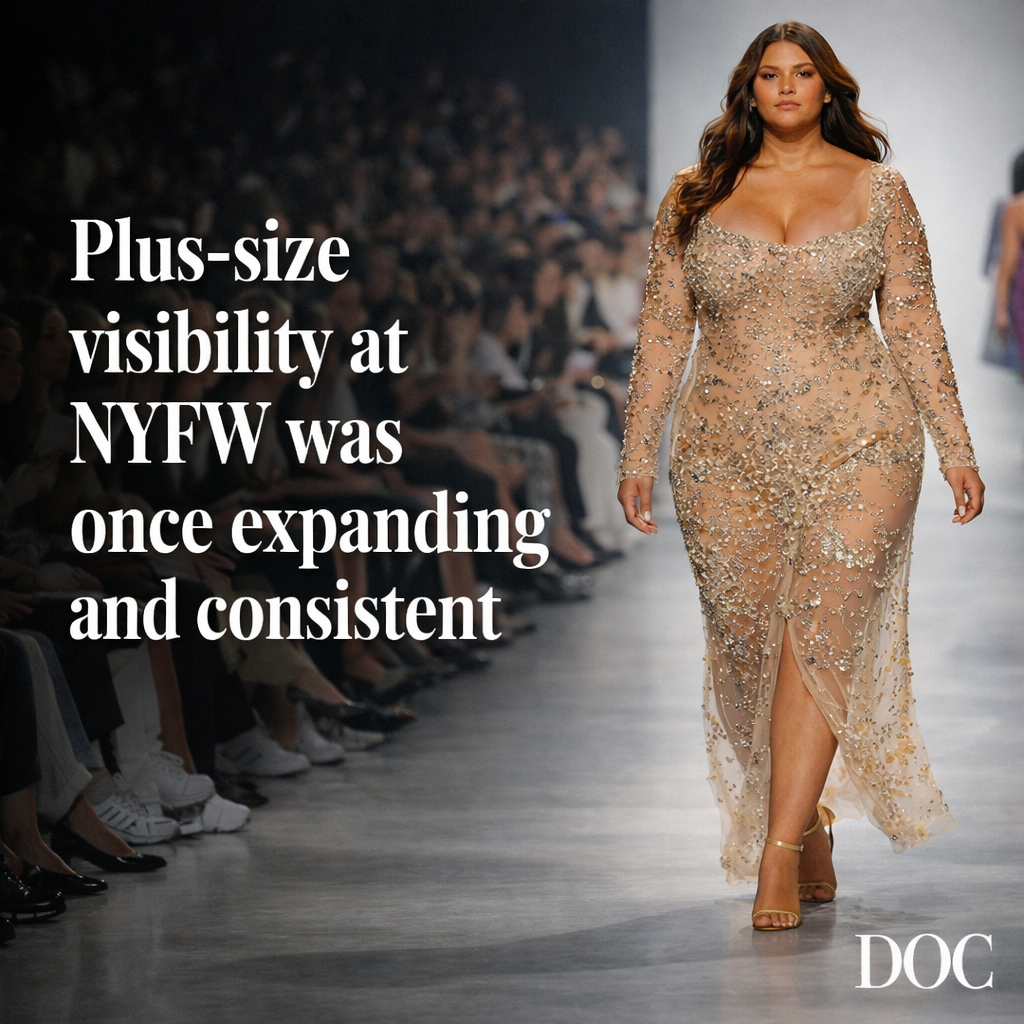
New York Fashion Week has always been about more than just clothes—it’s where the industry signals what (and who) matters. But this season, one of the loudest takeaways wasn’t a trend or a designer. It was the absence of size diversity on the runway.
After several years where progress felt visible and intentional, the Fall/Winter 2026 shows revealed a noticeable shift. Fewer plus-size models were cast across major runways, and when they did appear, it was often limited to a small group of designers who have consistently carried the responsibility of inclusive casting.
This isn’t a new conversation—but it’s one that’s resurfacing with urgency.
A Decline That’s Been Building
Industry data has been pointing in this direction for a while. According to reporting by Refinery29, plus-size representation on the runway has dropped significantly over the past few years. What once approached nearly 3% of total castings around 2020 has fallen to under 1% in more recent seasons.
That number might seem small on its own—but in an industry that sets global beauty standards, even incremental visibility matters.
Other fashion watchdogs, including The Fashion Spot, have also tracked similar patterns, noting that size inclusion often fluctuates depending on which designers show each season rather than being embedded across the industry as a whole.
In other words, representation still isn’t systemic—it’s selective.
When Inclusion Depends on Who Shows Up
For years, designers like Christian Siriano have been credited with consistently casting models across a broader size range. His shows have often served as a benchmark for what inclusive fashion can look like when it’s done intentionally.
But that highlights the underlying issue: when only a handful of designers prioritize inclusion, the entire conversation becomes fragile.
If those designers skip a season, reduce their casting, or simply aren’t part of the official calendar, representation drops—immediately.
That’s exactly what this season exposed.
The Industry Is Shifting—But Not Always Forward
There are larger forces at play here. Fashion is cyclical, and recent seasons have seen a resurgence of ultra-thin silhouettes, archival aesthetics, and “heritage” luxury branding. These shifts often influence casting decisions in ways that don’t prioritize size diversity.
At the same time, economic pressures are pushing brands to streamline production and marketing efforts. In many cases, that means defaulting to traditional standards that are seen as “safer” within the industry.
But safer for who?
For plus-size consumers—who make up a significant portion of the market—these decisions reinforce a familiar pattern: inclusion is embraced when it’s trending, and quietly scaled back when priorities change.
Representation Is Still Being Treated as Optional
What this season ultimately revealed is that size diversity still isn’t being treated as a baseline expectation. It remains a choice—one that brands can opt into or out of depending on their vision, strategy, or positioning.
And that’s where the problem lies.
Because when representation is optional, it becomes inconsistent. And when it’s inconsistent, it loses its impact.
Fashion doesn’t just reflect culture—it shapes it. The images that come off these runways influence everything from retail buying decisions to how people see themselves in everyday life.
So when entire body types are missing from that conversation, it sends a message—whether intentional or not.
Where Does the Industry Go From Here?
There are still designers, brands, and casting directors pushing for change. There are still moments of real inclusion happening on runways and in campaigns.
But moments aren’t enough.
For progress to hold, inclusion has to move from being a standout feature to a standard practice. That means consistent casting, broader sample sizing, and a shift in how the industry defines what fashion should look like.
Until then, seasons like this will continue to raise the same question:
Was the progress real—or was it temporary?
Sources
Refinery29 – Coverage of NYFW 2026 size diversity trends
The Fashion Spot – Runway diversity reports and casting data
Industry commentary and runway analysis from recent New York Fashion Week coverage (2025–2026 seasons)